
similar products:
Other People's Children: Cultural Conflict in the Classroom, Updated Edition
books

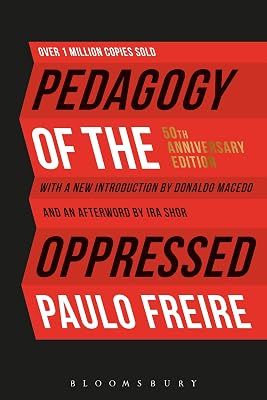
Pedagogy of the Oppressed: 50th Anniversary Edition
books
comments:
THE POLITICAL EVASION Visit a new teacher's classroom, and on the bookshelf behind her desk, you're likely to find a handful of books from education school, cherished influences and markers of commitment. Jonathan Kozol's Savage Inequalities. Lisa Delpit's Other People's Children. And Paulo Freire's Pedagogy of the Oppressed. Freire, a Brazilian philosopher and teacher, first published his book in 1968; the English edition arrived in 1970. A half-century later, the book had sold over a million copies, an extraordinary success for a theoretical tract on education. How to explain its reach? In a 2003 analysis of the syllabi of 16 top-ranked American education schools, researchers David Steiner and Susan Rozen found that Pedagogy of the Oppressed was one of the most assigned books in education-foundations classes. For a book ostensibly on the remaking of education, Freire had remarkably little to say about how schools should be run — what subjects and content children should be taught and at what age and with what methods, or how to raise achievement, especially among marginalized groups, in the service of equality of opportunity. Freire condemned traditional teacher-led education as a "banking" model, an act of domination where the teacher "makes deposits" into students, reducing them to "containers" or "receptacles" to be filled. The more students accept this passive role, the more they adapt to the world as it is rather than seeking to transform it. In contrast with the banking model, Freire's "liberating education" engages teachers and students in a mutual quest for "humanization." The student-teacher "contradiction" is resolved, rendering the "teacher-student" and the "student-teacher" coequals in a pedagogy of "problem-posing." Education becomes the practice of freedom rather than of domination. Students and teachers alike come to see the world not as an objective reality, but as reality in process, in transformation. Freire announces "critical pedagogy," which has dominated education schools ever since. But does Freire's problem-posing dialogue truly free students to think for themselves? As literary critic Gerald Graff has argued, "however much Freire insists on 'problem-posing' rather than 'banking' education...for Freire only Marxism or some version of Leftist radicalism counts as a genuine 'critical perception.'" It never occurred to Freire that a student might authentically believe or strive for something at odds with his views; this he dismissed as "false consciousness." The inherent inequality in power and experience between students and their teachers, Graff notes, often makes students fearful of challenging their teachers' political views. "What right do we have to be the self-appointed political conscience of our students?" he asks. Freire described a Manichaean society of "oppressors" and "oppressed," where teachers are unwittingly complicit in maintaining the oppressive order. Students, whom Freire analogized to slaves, accept their ignorance with a fatalistic attitude and fail to perceive injustice. The task of teachers is to awaken their students' "critical consciousness" so that they shed their false consciousness, recognize their oppression, and work toward their liberation. Liberation entails violent struggle to overthrow capitalist hegemony and establish a socialist utopia. That violence, Freire said, will be an "act of love." Freire saw the liberation he sought achieved in Mao's China. After the first stage of the pedagogy of the oppressed, where the oppressed "unveil the world of oppression," comes the second stage, where "the reality of oppression has already been transformed," and "this pedagogy ceases to belong to the oppressed and becomes a pedagogy of all people in the process of permanent liberation." This "appears to be the fundamental aspect of Mao's Cultural Revolution." It's an astonishing statement. When Freire's book was published in the United States, Chinese teachers and intellectuals were suffering persecution as schools and universities closed under duress. By some estimates, the Cultural Revolution's orgy of chaos and violence claimed the lives of millions. Even on Freire's revolutionary terms, his educational vision fails. Students cannot think, let alone "problem-pose" or transform the world they inherit, without an expansive, rigorous education that equips them with essential tools — of historical knowledge, analytic capacity, and oral and written expression. Freire and his learned followers attained their positions and livelihoods thanks to precisely such a rigorous education, which they seem intent on denying students. Freire placed "knowledge" in quotation marks, and to this day students at schools of education are known to hiss in class when the word is mentioned. Traditional disciplinary knowledge is tainted. But are the alphabet and phonics? Is the periodic table? Is math? Freire did not say. His adherents do. Deborah Loewenberg Ball, former dean of the University of Michigan's school of education and a professor of math education, claims that math is a "harbor for whiteness." In 2021, California's Department of Education proposed a new, 800-page math framework that would racialize the discipline. Explicitly rejecting math as a neutral discipline, the standards aimed to make math "relevant" by inflecting every unit with social-justice themes. Independent practice and getting the right answer would be cast aside. In a scathing response, more than a thousand signatories — mostly academics — sent an open letter to Governor Gavin Newsom and the state superintendent of public instruction. The proposed curriculum "is presented as a step toward social justice and racial equity," they wrote, "but its effect would be the opposite — to rob all Californians, especially the poorest and most vulnerable, who always suffer most when schools fail to teach their students." Consigning students to unchallenging classes is "immoral and foolish," and politicizing math abhorrent. We believe that the modern world of science and technology — and of constitutional democracy, human rights and expanded opportunity for all — arose largely because societies learned to value inquiry that was disinterested (i.e., "objective" and "neutral"), rational and coherent. It arose by moving away from judging ideas on the basis of cultural origins and group identity in favor of judging them according to their real merit. Undeterred, the California State Board of Education in 2023 approved final standards that politicize math as "a toolkit and mindset to identify and combat inequities with mathematics." Most students, the standards envision, will take algebra in ninth grade and not in middle school, slowing their progress and diminishing their eligibility for STEM programs in college. By the board's logic, teaching students less math advances "equity." What of literature? A document widely used in teacher professional development — including for all New York administrators in 2019 — identifies "worship of the written word" as a symptom of "white supremacy culture." (Co-author Tema Okun says her ideas have been misused and weaponized.) Even Shakespeare, some equity advocates argue, should be discarded from the curriculum. "Everything about the fact that he was a man of his time is problematic about his plays," said Lorena Germán, cofounder of the #DisruptTexts movement and chair of the Committee Against Racism and Bias in the Teaching of English of the venerable National Council of Teachers of English (NCTE). "Antiracism is a verb," the NCTE declared in its 2021 standards training secondary-school English teachers. The following year, it announced in a position paper that "[t]he time has come to decenter book reading and essay writing as the pinnacles of English language arts education." A clear through line runs from Freire's book to today's illiberalism and intolerance. Students of his work today are free to claim any slight, any heterodox opinion that they are obliged to encounter, any criticism of their academic work, as an act of oppression. It is Freire's legacy that many education leaders and individual teachers unhesitatingly see their purpose as shaping students' political views, rather than educating them to reach their own conclusions. For half a century, schools of education have trained their students to think of politics and education as inseparable. As David Corey wrote in these pages responding to Freire's pedagogy, "[l]iberal education encourages students to admit their own ignorance, to view themselves as morally and intellectually incomplete." Liberatory education, by contrast, by locating the source of all dissatisfaction outside the self — in oppression — "offers virtually nothing by way of cultivating virtues or developing students morally and intellectually." The Political Evasion's obliteration of neutrality in education, and its insistent anti-intellectualism, continue to undermine the very students they seek to aid. Teachers are absolved of their responsibility to teach, and students of their responsibility to grow. [ANOTHER SECTION BELOW] !ping EDU