comments:
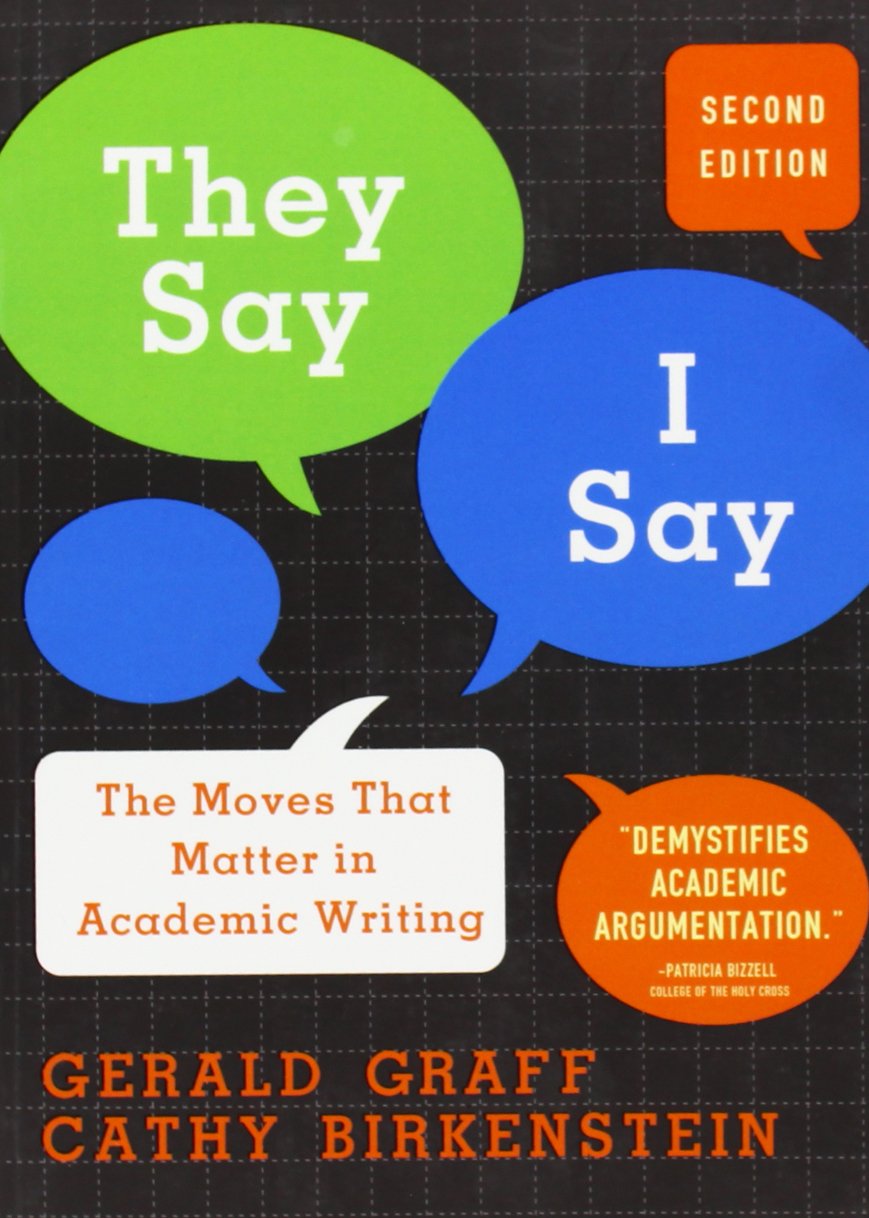
https://www.amazon.com/They-Say-Matter-Academic-Writing/dp/039393361X This is a great book that teaches how to frame arguments.It should be taught in all high schools, colleges, and law school, in my opinion. Very basic, very straightforward, shows you models of how you can easily do it. If you want to become a master at it, read James Taranto's columns from the Best of the Web Today from the Wall Street Journal before he moved on to the editorial board. Not an attorney, but he is an absolute master at it. Here are some examples that I've collected when I run across them in various sources over the years. a passage in ____ that @@ appears to have overlooked: @@ license[d] one side of a debate to fight freestyle, while requiring the other to follow Marquis of Queensberry rules. See R.A.V. v. City of St. Paul, 505 U.S. 377, 391 (1992) By their logic � plaintiff's logic would seem to dictate � But more importantly, Plaintiffs attempt to downplay the significance of @@ However, that would be the eventual result if � No court has squarely addressed the issue of @@ To the extent plaintiffs are claiming @@ To the extent plaintiffs may say | allege @@ The retreat to euphemism [or @@] is most telling. It is at least debatable Now, let us stipulate that we do not assert. Serious but respectful discussion Left with a familiar pattern, @ assert that @@. @@ do not offer any proof of this proposition, treating it as self-evident. For one thing, Let's be clear. @@ would never ... Still, To be clear, Obviously, @@ will disagree with @@. @@ hopes that any disagreement will be based on a full understanding of our position and not on distortion or selective interpretation. @@ presupposes @@--admittedly a common supposition Let's wade into an argument, and on what may well be the losing side. False paradox: There are two kinds ... or There are two ways Inasmuch as @@ is arguing that @@, [restate position], we tend to agree. @@ makes one other argument that deserves a response @@ suggests @@. This is not entirely wrong, but it misses the point. @@ Put like that, of course, it sounds ridiculous, but the fact So yes, @@ though ... but only because @@. Likewise, @@ The solution to this problem isn't @@, as @@ argues, but @@ apparently, the only @@ that can @@ is @@; but @@ is not at all the same as saying it is @@; @@ conveniently conflates the two. At this point in the discussion, one will usually hear @@. This argument assumes @@. Of course, none of this is definitive proof, and I don't want to overstate my case here. This is the point that @@, in general, misses. To respond to one last argument on this issue, @@ Some @@ will object to this analogy and claim that @@ is more akin to @@ than @@. It is worth noting in response that @@ This is one of those heads-I-win-and-tails-you-lose arguments. Even if @@ [event happens], @@ can always say that it would have worked if only @@ had @@ [event]. @@ scores a small point: @@. But that is beside the larger point; context gives more meaning: @@ is at it again, trying to win arguments by name-calling.