comments:
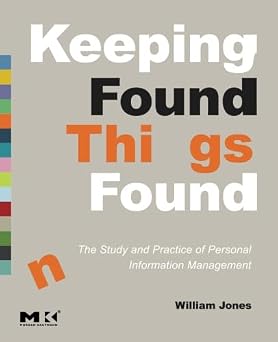
I have a bunch of books on PIM, and the only one I'd actually recommend is "Keeping Found Things Found: The Study and Practice of Personal Information Management" https://www.amazon.com/dp/0123708664 William P. Jones Paperback: 448 pages ISBN-10: 0123708664 ISBN-13: 978-0123708663 Provides a comprehensive overview of PIM as both a study and a practice of the activities people do, and need to be doing, so that information can work for them in their daily lives. It explores what good and better PIM looks like, and how to measure improvements. It presents key questions to consider when evaluating any new PIM informational tools or systems. http://susandumais.com/CIKM%20paper%20camera-ready.pdf [The book above is an expanded version of this.] This paper describes the results of an observational study into the methods people use to manage web information for re-use. People observed in our study used a diversity of methods and associated tools. For example, several participants emailed web addresses (URLs) along with comments to themselves and to others. Other methods observed included printing out web pages, saving web pages to the hard drive, pasting the address for a web page into a document and pasting the address into a personal web site. http://www.matthewcornell.org/blog/2005/8/21/my-big-arse-text-file-a-poor-mans-wikiblogpim.html My Big-Arse Text File - a Poor Man's Wiki+Blog+PIM Matthew Cornell Sun, 21 Aug 2005 11:32:00 -0400 I've been using a plain text file for my professional log/diary/journal/notes since Thu Sep 28 10:57:09 EDT 2000. In this post I'd like to talk about how I use the file, in hopes that it will give me some motivation and ideas. https://bezoar.org/posts/2020/0203/organizing-my-stuff/ If you don't mind some shameless self-promotion, I wrote an article for O'Reilly and Assoc. in 2003 that's since been taken down or archived or something, so I put it on my own page: https://firstmonday.org/ojs/index.php/fm/article/view/1123 To keep or not to keep? People continually face variations of this decision as they encounter information. A large percentage of information encountered is clearly useless -- junk email, for example. Another portion of encountered information can be "used up" and disposed of in a single read -- the weather report or a sports score, for example. That leaves a great deal of information in a middle ground. The information might be useful somewhere at sometime in the future. Decisions concerning whether and how to keep this information are an essential part of personal information management. Bad decisions either way can be costly. Information not kept or not kept properly may be unavailable later when it is needed. But keeping too much information can also be costly. The wrong information competes for attention and may obscure information more appropriate to the current task. These are the logical costs of a signal detection task. From this perspective, one approach in tool support is to try to decrease the costs of a false positive (keeping useless information) and a miss (not keeping useful information). But this reduction in the costs of keeping mistakes is likely to be bounded by fundamental limitations in the human ability to remember and to attend. A second approach suggested by the theory of signal detectability is relatively less explored: Develop tools that decrease the likelihood that "keeping" mistakes are made in the first place.